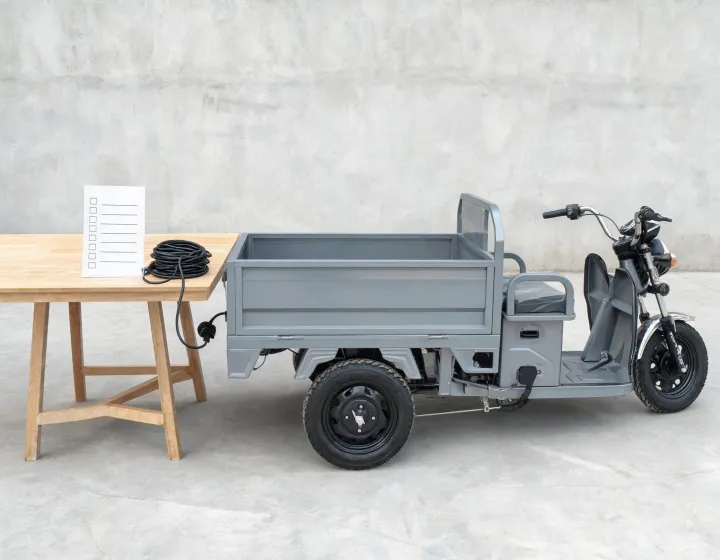
Imagine two Rad Power Bikes RadTrike 2023 units leaving the same depot with the same load on the same suburban loop. The first rider built the route before the cargo box was filled: every candidate grade got converted to a percentage, checked against the ceiling in the manual, and the two segments that broke it were swapped for a longer, flatter line. The second rider took the line he rides every morning empty. The gap opens at the third stop, where one trike is still rolling and the other has been walked down the last hundred feet.
The difference is narrow: hill routing for a loaded electric cargo tricycle is a grade-versus-payload calculation first and a riding skill second. Nothing below is a claim about cargo trikes in general. Every limit, warning and number here belongs to the RadTrike 2023 and to the owner's manual shipped with that model in the US; run a different trike and the method transfers while the figures do not.
When a Routine Hill Becomes a Loaded Hill
The angle of a hill does not change when you load the box. What changes is the share of weight pushing along the slope and the mass that has to be stopped at the bottom. Those are two budgets drawn on the same account, because every pound of cargo raises the force the motor and your legs must overcome going up, and the energy the brakes must absorb coming down. Both margins shrink together, which is why a hill that sits comfortably inside the trike's capability empty can sit outside it loaded. The manual says it in plainer words: hills that are normally easy to climb or descend without cargo can become challenging or even dangerous once extra weight is loaded onto the trike.
Motor strain tracks the same curve: the steeper the hill and the heavier the load, the more the assist matters for holding speed and for keeping the draw on the motor down. Grade also changes how the vehicle steers, and the manual rates that effect as significant rather than subtle. Making it up and keeping it pointed where you want are two different questions, and a loaded route has to answer both.
What the 10–15 Percent Grade Limit Really Means
Percent grade is vertical rise divided by horizontal run, multiplied by one hundred. That single ratio is why the same vertical gain reads as steeper as the run shortens, and why a climb that looks gentle on a map can measure steeper than a short pitch that looks dramatic. The visual read of a hill tells you almost nothing about the number you actually need, and the ceiling is written only in that number.
The manual's instruction is not to ride up or down very steep hills, described as about 10–15% grade or more, and it attaches a qualifier that matters more than the figure itself: it depends on your payload and your readiness to pedal. Read that as a moving ceiling rather than a fixed wall. A ten percent grade with a light box and a willing rider is a different proposition from fifteen percent with a full box and a rider coasting on assist. The ceiling is not a category standard and should not be quoted as one; it is the figure this model's documentation attaches to this model, and any other trike needs its own paperwork checked before you borrow it.
Build the Route in This Order
Start with the load, not the hill. Fix the worst-case payload the trip will carry, because that number drives everything downstream and it is the number people estimate last. Then walk the candidate segments one at a time and convert each to a percent grade from the rise and run you can measure or read off a mapping tool, so the comparison is between numbers, not impressions. Mark every segment that breaks the ceiling and find its alternate on the same pass, while you are still at a desk. Write the turn points, the cross-slope stretches and the pre-brake positions onto the route sheet. Re-check climb margin and motor strain against that payload before the box gets loaded.
Doing it in that order costs something, and the cost should be stated plainly. A route sized against the full box is usually longer and slower than the line you would pick empty, and it deletes short steep connectors that are perfectly serviceable on an empty return leg. Flip the order only when three conditions hold at the same time: the trike is running empty or close to it, the segment is short enough that you never build real speed on it, and the rider is committed to pedaling the entire climb. Change any one of those and the steeper direct line comes off the sheet.
Order matters because of timing: a routing error caught on paper costs a redraw, while the same error found at the foot of a grade with a full box costs a turnaround in traffic or a decision made in the worst possible place. Errors in a hill route surface only after loading, and that is when fixing them is most expensive.
Critical Points at the Crest, Slope and Turn
On the climb itself, the critical quantity is handling margin rather than torque. The trike will usually still move; what degrades first is your ability to place it precisely, because increased grades change the trike's handling significantly and the same steering input gives a different result on a slope than on the flat. If a loaded climb needs a correction mid-grade, you have already spent margin you did not have.
At the crest and at every turn, the critical quantity is speed. Slow as much as possible before turning, then turn gradually rather than sharply: that is the manual's instruction, with extreme caution when turning uphill and no leaning downhill. Those are not three separate rules; they are one rule applied at three points on the route sheet, and each needs a marked position where the slowing happens. Deciding to slow down once you are already into the turn is not slowing down, it is braking in a corner.
Across a slope, the critical action is simply not to travel across it. Riding across a slope tilts the trike and raises the risk of tipping, and a tilt is not something you can brake your way out of mid-traverse. The route either goes straight up and down that face or it goes around it, and a loaded box makes that choice for you rather than leaving it to judgment on the day.
All three points share one mechanism. A trike's lateral stability comes from its track width, the distance between the rear wheels, and from where the center of mass sits inside that footprint. Anything that moves the mass sideways relative to the wheelbase spends the margin the third wheel was supposed to provide, which means a sharp turn, a cross-slope traverse and a downhill lean are the same mistake in three costumes. That is why the route is drawn up in advance: on paper the geometry is visible; in the moment you feel it only after it has gone wrong.
Braking and Speed on a Loaded Descent
Braking distance grows under three conditions the manual names together: speed, extra weight and slippery surfaces. Both braking systems are meant to work together, hand brake and coaster brake, rather than one alone. A loaded descent on a damp morning stacks all three conditions at once, and the route has to reflect the stack rather than the dry baseline.
PAS stands for pedal assist system, the motor that adds power while you turn the pedals. It stops contributing once you reach its speed limit, but the trike does not stop there: you can still go faster than that limit by pedaling harder or by simply descending. The assist governs the climb and then steps out of the descent entirely, so the hill you climbed with help is the hill you descend on gravity alone, and gravity carries no speed limiter and no interest in your payload.
Why a loaded descent needs more room comes down to energy rather than brake condition. Gravity keeps adding kinetic energy the whole way down, while the brakes can only remove it at a rate set by tire grip and brake capacity. Add cargo and the energy that must be shed before the wheels stop turning rises with the mass, so the distance needed to reach zero speed rises with it.
How to Confirm the Plan Before You Commit
Three checks close out a route before the box is filled. The steepest segment should sit below the manual's ceiling with a visible gap left over, measured as a percentage rather than felt as a slope. Every turn needs a written braking point ahead of it, so nobody is counting on a sharp correction to save the corner. Descents need their brake points at loaded distances, with the extra time and distance the manual asks for built in rather than hoped for.
Suppose one segment reads twelve percent and the turn at the bottom is blind because a wall or a hedge blocks the view. The correct outcome is not to ride it slowly and see how it goes; it is that this segment does not belong in the loaded route today. It goes back on the alternates list and returns only on a day when the box is empty and the rider intends to pedal the whole climb. That is a routing decision made with a full view of the conditions, which is the only place it can be made safely.
All three checks resolve to one question: is there enough margin left to correct a mistake, whether steering margin at the climb, time margin at the turn or distance margin at the brake point? Because they collapse into that question, confirmation takes minutes rather than a rehearsal run, and it works on a route nobody has driven before.
When to Reroute Instead of Riding It
The ceiling in the manual moves with payload and with how willing the rider is to pedal, which is exactly why careful riding cannot substitute for rerouting. If the usable limit shifts down as the box fills, the segment that was legal this morning may not be legal this afternoon, and no amount of caution changes the arithmetic. A cross-slope leaves even less room for judgment: there is no careful way to traverse it, because the tilt is geometric and the tipping risk arrives with it. And the manual reserves its harshest language for downhill control, warning that failing to control speed or turning sharply on a descent raises the risk of losing control, with serious injury or death as the outcome.
The judgment therefore has to change shape. The question is not whether you can get the loaded trike over a given grade; on many grades the honest answer is that you probably can, once, carefully. The question is whether that segment still leaves braking and steering margin when the box is full. When the margin reaches zero, the only correct action is a different line, and it does not matter how experienced the rider is or how many times the empty trike has made it. Back at the depot, that is the difference between the two units: one arrived on a route whose steepest segment had been marked before loading and re-checked against the payload, and the other arrived on luck.

Leave a comment
Do not include confidential procurement data in a public comment. Use the inquiry form for sourcing requirements.