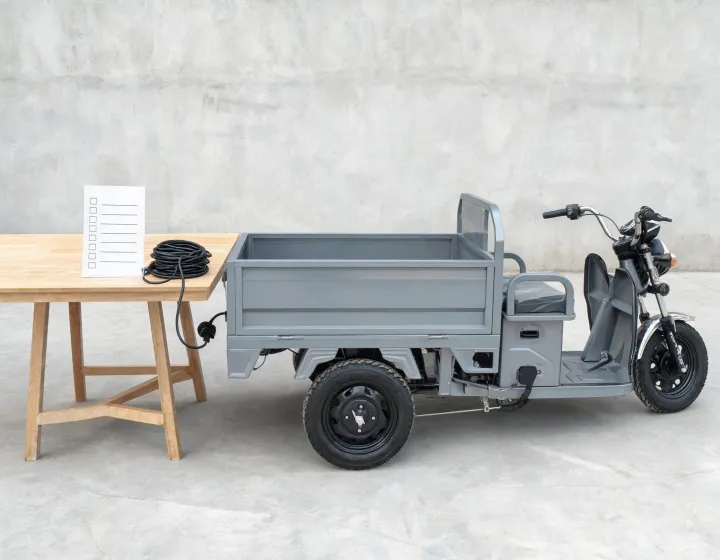
A 325 lb rider on a RadTrike 2023 uses up all but 90 lb of the trike's 415 lb total carrying capacity. Everything else — clothing, riding gear, accessories, cargo — has to fit inside those 90 lb. Operators who read 415 lb as cargo room are planning a load the vehicle was never rated to carry; the manual ties overloading to component failure and loss of control.
The figures below come from the Rad Power Bikes RadTrike 2023 US owner manual and hold for that model as equipped, not for cargo trikes in general. The working rule: usable payload is the smallest remaining allowance after subtracting rider, gear and accessory weight from the 415 lb total and from each rack limit separately. What follows is the subtraction order, the component ceilings that override the arithmetic, and the checks to run before the trike leaves the dock.
The 415 lb figure includes you
The manual states that total maximum carrying capacity includes the weight of the rider as well as clothing, riding gear, cargo, accessories and similar items. It is a gross figure: the operator sits inside the number, not on top of it. On this model the rider ceiling is 325 lb (147 kg), the rear rack is rated to 60 lb (27 kg), and the optional front rack to 30 lb (14 kg). Any cargo allowance is what remains after those limits are satisfied, which is why the total itself cannot be treated as cargo space.
That residue is the number to carry in your head, and it is not a target. It is what is left after one rider at the heaviest the manual permits, before a single box goes on a rack.
The weakest component sets the real ceiling
Payload plans break here. The manual warns never to exceed the payload limit of any accessory or component even if you attach an accessory that carries a higher weight limit. A basket rated above the rear rack does not lift that rack to the basket's rating; the rack stays at 60 lb and the basket merely makes overloading easier to do. Overloading any component can cause component failure, loss of control, serious injury or death.
The reason comes down to how load travels. Every pound passes through a chain of parts — rack, mounting hardware, frame, axle, wheel, tire — and a chain fails at its narrowest link, not at its widest claim. Which means the usable ceiling for a given position is the lowest applicable limit in that load path, never the highest-rated part bolted onto it. A component rated above its host adds no strength; it only hides how much load the host is actually taking.
Subtract rider and gear before cargo
Start at 415 lb. Subtract the rider, the clothing, the riding gear and every accessory already on the build, then allocate what remains to cargo.
The order matters because the 415 lb total already contains the rider, so subtracting rider weight later — or never — counts the same pounds twice and inflates the cargo allowance. Do the subtraction once, at the start, in that sequence. Then split the remaining cargo by position: rear cargo answers to the 60 lb rear rack and front cargo to the 30 lb front rack, whatever the leftover total happens to be. Which means a light rider with a generous total still cannot exceed the 60 lb rear-rack limit, because the component ceiling binds before the arithmetic does. Run both comparisons and take the smaller result for each position. The binding limit, not the total, is what goes on the load sheet.
Suppose a 190 lb rider wears 12 lb of clothing and gear and the build carries 13 lb of accessories; that leaves 200 lb of the total unspoken for, yet the racks still offer only 60 lb at the rear and 30 lb at the front. In that configuration the racks bind long before the total does, which is the practical reason a single gross number makes a poor planning figure for a fleet.
The rear rack and front rack do not add
Sixty plus thirty is ninety, and that ninety is not extra capacity. Both rack ratings live inside the 415 lb total, because the total already accounts for cargo and accessories. Fitting both racks gives two places to put weight that still answer to the total and to their own limits. The reason is plain enough: a rating on a rack describes what that rack and its mounts will take, not what the frame, wheels and brakes will accept with a rider aboard.
So the calculation runs twice. First the remaining total, 415 lb minus rider, gear and accessories. Then position — rear cargo against 60 lb, front cargo against 30 lb — with the smaller figure controlling each position. Suppose the remaining total is 40 lb and the rear rack is rated to 60 lb; the rear cargo allowance is 40 lb.
Verify every limit before you release the brake
Loading is its own hazard on this model. The manual cautions that loading cargo can cause the trike to roll forward or backward or tip over, leading to damage or serious injury, and it instructs the operator to hold the trike and/or set the parking brake when loading or unloading. A free-rolling trike on a grade moves, and holding the trike or setting the parking brake is what keeps it from moving. The manual already ties extra weight to longer stopping time, so settle the numbers before loading rather than after.
The checks, in order. Compare the calculated all-in weight against 415 lb, using the real rider weight rather than the 325 lb ceiling when the rider is lighter. Compare rear cargo against 60 lb and front cargo against 30 lb separately, and check any added component against its own rating. Confirm that nothing in the load can interfere with the operator's control — the manual warns that failing to ensure this can lead to serious injury or death, which puts straps, overhanging boxes and loose covers inside the payload problem. Confirm, finally, that the operator has secured the loads, straps and gear, since that responsibility stays with the operator on every trip.
Braking distance is a payload symptom
Extra weight increases the time it takes to slow the trike when braking. That is the manual's direction rather than a measured result, and the reason is momentum: the same brake system has to shed more of it, so the same lever pull produces a longer stop. Route planning therefore belongs inside payload planning. A load that passes the arithmetic on a flat yard loop behaves differently on the approach to a ramp or a downhill bay, and an empty trike's stopping behavior is not a guide to a loaded one. The manual gives direction, not a stopping-distance figure, so treat the effect as a planning input and keep margin rather than computing a false precision.
When this trike is the wrong tool
If rider plus clothing and gear plus the required cargo does not fit under the smallest remaining allowance — the 415 lb total, the 60 lb rear rack, the 30 lb front rack — the RadTrike 2023 is the wrong vehicle for that job, and careful loading will not rescue it. The same answer applies when a route depends on carrying more than the racks will hold. This is a fit test for one model as equipped, not a verdict on cargo trikes generally, and the numbers should not be carried across to another trike without that trike's own manual.
Operators whose real loads exceed the binding limit, or whose heaviest rider leaves nothing for cargo, should not buy this model and try to manage the gap. It fits the operator whose rider, gear and load stay under the smallest remaining limit and who will weigh the load and check each component at the point of loading, every trip.

Leave a comment
Do not include confidential procurement data in a public comment. Use the inquiry form for sourcing requirements.